
Cisco ACI Special Considerations
|
Applied version
|
Cisco ACI Special Considerations
(1) TEP Pool and Infrastructure VLAN
- TEP Pool
- Tunnel endpoint address pool
- IP addresses from this pool are assigned to all fabric elements to communicate over the infrastructure VLAN
- “This subnet should not overlap with any other routed subnets in your network”
- If this subnet does overlap with another subnet
- Change this subnet to a different /16 subnet
- The recommended minimum mask is /19
- If you want to change this later on, the procedure is very
- Infrastructure VLAN
- In-band VLAN
- Allows APIC to communicate with leafs and spines
- Changing TEP Pool and Infra VLAN after the initial provisioning
- Changing either the infrastructure IP address (TEP IP pool) range or the infra VLAN after the initial provisioning setup process is not possible without rebuilding the fabric.
- Procedures (reinitialize the APICs and the leafs):
- Login to the Fabric, and take the backup (save it locally)
- Delete all the configuration
- Reinitialize the Fabric again (APICs and the leafs)
- Set the correct value for TEP Pool and Infra VLAN
- Restore the backup
- Infrastructure VLAN and TEP Pool will be extended
- Hypervisor integrations, such as OpenStack, Kubernetes, etc
- Because a lot of these platforms don’t implement VRF
- MultiPOD design
- Hypervisor integrations, such as OpenStack, Kubernetes, etc
- OpenStack integration example
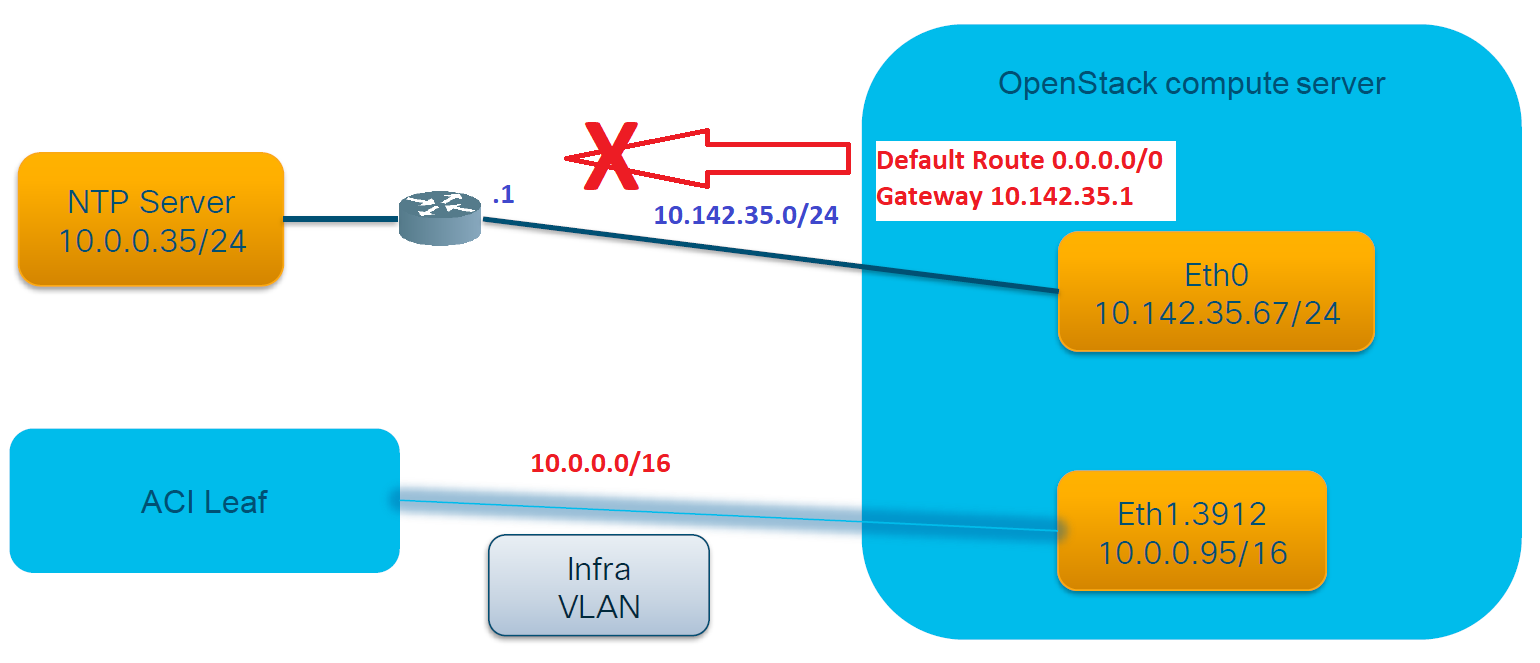
- You might have connectivity issue if the Infra VLAN segment does overlap with another segment in your network
- In this case, the Openstack compute server won’t be able to reach NTP Server 10.0.0.35
- Because default route 0.0.0.0/0 will lose against 10.0.0.0/16 and there is no VRF implementation
(2) UCS-B connectivity with VMware
- Each Fabric Interconnect has a port-channel (vPC) towards the ACI leafs
- We can use switch dependendent protocol, such as LACP
- Fabric interconnects are connected for clustering
- No data traffic is on the links
- For example: can’t form vPC peer link using this links
- The hypervisor running on a blade has 2 independent connections
- No switch dependent procotols can be used
- > Using LACP IP-hash algorithms will cause MAC flaps on the UCS FI’s and N5K;s
- Use switch independent protocol instead
- > MAC Pinning-Physical-NIC Load for vSwitch policy
- No switch dependent procotols can be used
0 Comments